

In 2025, the Bank Guarantee Fund celebrates its 30th anniversary. We are proud of the Fund’s achievements in deposit protection and its contributions to the stability of the national financial system. At the same time, we are looking to the future. Based on our accumulated experience, the best international standards, and the full commitment of our employees, we intend to build a modern and efficient institution in the coming years. That is why, for the first time in BFG’s history, we are presenting a long-term operational strategy for 2025–2030. Its central focus is the depositor. We invite you to read on.
Call for papers: Safe Bank (Bezpieczny Bank) Journal is dedicating an issue to crypto assets
Crypto-assets not only attract widespread public interest, but they also create new risks in the financial market on a large scale that are difficult to accurately assess. Both the nature of the risk and the magnitude of the problem have made these financial instruments a subject of analysis by academics and a serious concern for supervisors and regulators in many countries.
In the EU, one outcome of these efforts is Regulation (EU) 2023/1114, known as MiCA (Markets in Crypto-Assets). This regulation introduces uniform rules for issuers and service providers related to crypto-assets that were previously not subject to specific financial instrument regulations.
The relevance of the crypto-assets issue is also underscored by the declaration of the new American administration and by the final stage of legislative work on implementing the EU Regulation into national law. Ultimately, the aim is to limit the risk to which individuals—lured by the prospect of extraordinary financial gains—may be exposed. In light of recent and past experiences, crypto-assets represent a serious challenge to public financial education.
The Program and Scientific Council and the Editorial Committee of “Safe Bank” invite submissions for the special issue No. 2(97)2025, dedicated to crypto-assets.
The academic advisor and editor of the issue will be Chair of the Polish Financial Supervision Authority (KNF) Jacek Jastrzębski, professor at the University of Warsaw.
Article topics may cover issues from the social sciences—especially economics and finance, legal studies—as well as from computer science, technical computer science, and telecommunications. We encourage a broad treatment of crypto-assets, including their impact on the financial market, investor preferences, the diverse approaches of different age or social groups, competition with traditional products, and potential threats to certain financial sector entities.
We are also interested in analyses of EU regulations and their consequences for national standards, as well as studies on the situation of market participants in the financial sector.
Proposals for topics and articles should be submitted in both Polish and English. For submissions by foreign authors, the English version alone will suffice.
Manuscripts should not exceed 20 standard typewritten pages (up to 36,000 characters without spaces per language version). In cases of significant discrepancies, the English version will be considered definitive.
The issue will also include content from the debate titled “Crypto-Assets Storm the World of Finance,” held during a seminar organized by the European Financial Congress, the International Monetary Fund, and the Financial Supervision Authority (UKNF) in Warsaw on 28 February 2025.
Detailed editorial requirements are available on the “Safe Bank” website at ojs.bfg.pl under the “Information for Authors” tab.
Deadline for submission of article topics: 30 March 2025
Deadline for submission of article manuscripts: 15 May 2025
For topic proposals or any inquiries, please contact: redakcja@bfg.pl
Jan Szambelańczyk – Editor-in-Chief
Jacek Jastrzębski – Chair of the KNF
Andrzej Sławiński – Chair of the Scientific Council
BGF sets banks’ 2025 contributions at PLN 2,706 million
- Following a two-year pause, the Bank Guarantee Fund (BGF) has resumed collecting contributions from banks for the Bank Deposit Guarantee Fund, as it fell below the 1.6% target level.
- A 20% increase in covered deposits since the end of 2022 is the main driver of the total contributions.
- The BFG’s net profit for 2024, approximately PLN 1,300 million, helped limit the overall level of contributions.
The Council of the Bank Guarantee Fund has set banks’ total contributions for 2025 at PLN 2,706 million. The contributions are composed of:
- Bank Deposit Guarantee Fund at PLN 893 million
- Bank Resolution Fund at PLN 1,813 million
Over the past two years, BFG has not collected contributions for the Bank Deposit Guarantee Fund. However, due to the rapid rise in covered deposits over the past two years, in 2024 the Bank Deposit Guarantee Fund fell below the target level of 1.6% of covered deposits. By law, this requires the BFG to resume collecting contributions to this fund. In parallel, contributions to the Bank Resolution Fund rose by 16% y/y, to PLN 1,813 million from PLN 1,563 million.
BGF Information on the CJEU Judgment in Case C-118/23 (Getin Holding and Others)
On 12 December 2024, the Court of Justice of the EU (CJEU) announced its judgment in Case C-118/23 on the preliminary questions submitted by the Provincial Administrative Court (WSA) in Warsaw. These questions were raised in connection with the ongoing judicial review of the administrative decision of the Bank Guarantee Fund (BGF) regarding the resolution of Getin Noble Bank S.A.
The WSA in Warsaw formulated four questions for the CJEU. Two of these questions (Questions 1 and 2) addressed procedural issues concerning the administrative court’s consideration of complaints against decisions of the BGF. Therefore, the position presented today by the CJEU on these procedural questions does not concern or directly affect the BGF.
From the BGF’s perspective, the answers to Questions 3 and 4 were of particular importance, as they pertain to the correctness of the organisational solutions adopted by the BGF. These solutions involve combining different types of functions within a single structure—namely, the functions of the resolution authority, the deposit guarantee scheme, and the interim administrator, as well as the curatorial function under Polish law.
A preliminary analysis of the answers to Questions 3 and 4, announced orally, indicates that the CJEU did not fundamentally question the permissibility, under European law, of combining these various functions within a single entity. However, the CJEU emphasized the necessity of adopting appropriate organisational arrangements to prevent conflicts of interest during the implementation of these functions. This is significant, as it confirms the legality of the systemic and organisational solutions adopted by the BGF, which is crucial for the decision to initiate resolution. Contrary to the doubts raised by the WSA in Warsaw, the CJEU recognised that the coexistence of entities and organisational units within the BGF that perform multiple functions simultaneously is permissible under European law.
Notably, the CJEU stated that in the absence of explicit legal regulations ensuring the independence of individual functions, the adoption and observance of internal organisational measures and other arrangements to prevent conflicts of interest would suffice. From the perspective of the case under review by the WSA in Warsaw, it is particularly important that, according to the CJEU, the lack of publication of information regarding the internal solutions adopted to separate individual functions does not, in itself, invalidate the resolution decision.
Based on the CJEU’s orally communicated answers to the preliminary questions, it can be concluded that the CJEU’s position is generally favorable to the BGF. The court did not question, under European law, the solutions and actions undertaken by the BGF at the stage preceding the issuance of the decision to initiate resolution. The overall assessment of the legality of the decision will, however, be made by the national administrative courts, taking into account today’s position of the CJEU.
It should also be noted that the decision to initiate resolution of Getin Noble Bank S.A. was made solely to achieve the objectives of resolution. These objectives include maintaining the stability of the Polish financial sector and protecting the security of the bank’s clients’ funds.
Link to the CJEU press release: https://curia.europa.eu/jcms/upload/docs/application/pdf/2024-12/cp240197en.pdf
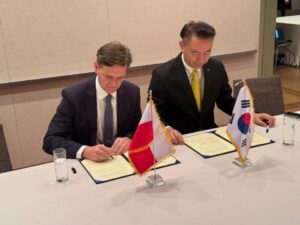
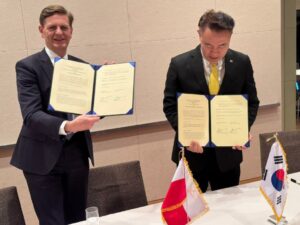
The Bank Guarantee Fund Signs MoU with the Korea Deposit Insurance Corporation (KDIC)
On November 12, 2024, the Bank Guarantee Fund, Poland’s Deposit Guarantee Scheme, signed a Memorandum of Understanding (MoU) with its Korean counterpart, the Korea Deposit Insurance Corporation (KDIC). The agreement was signed by Maciej Szczęsny, President of the Management Board of BFG, and Yoo JaeHoon, KDIC Chairman and President, during the Annual General Meeting of the International Association of Deposit Insurers (IADI) in Tokyo.
The Memorandum aims to enhance cooperation between BFG and KDIC, promoting the exchange of perspectives, information, and expertise.
Information on the sale of 100% of VeloBank S.A. shares
The Bank Guarantee Fund on 1 August signed a final agreement for the sale of 100% of the shares in VeloBank S.A. (‘Bank’) to Promontoria Holding 418 B.V., which is indirectly owned by Cerberus Capital Management, L.P., the European Bank for Reconstruction and Development (“EBRD”) and the International Finance Corporation (“IFC”, a member of the World Bank Group). The sale of the bank marks the completion of the nearly two-year-long resolution process of GNB and the fulfilment of its obligations towards the European Commission, which closely monitored the resolution process of Getin Noble Bank S.A. and the sale of VeloBank S.A.
The purchase price of the shares amounts to PLN 375 million, while the recapitalisation of the Bank by the purchaser will amount to PLN 687 million. This is the amount of recapitalisation necessary to achieve the required safe capital ratios agreed in the negotiation process, taking into account the Bank’s current financial position and balance sheet structure.
The process of resolution of Getin Noble Bank S.A. (‘GNB’) began on 30 September 2022, when the BGF made an irrevocable decision to transfer part of GNB’s business to a bridge institution: VeloBank S.A. The BGF’s decision to initiate a resolution protected all GNB depositors and all of their deposits amounting to PLN 38.1 billion (as at 30 September 2022). The process was carried out in cooperation with the System for the Protection of Commercial Banks S.A. (‘SOBK’), consisting of the eight largest commercial banks operating in Poland (Alior Bank S.A., Bank Millennium S.A., Bank Pekao S.A., BNP Paribas Bank Polska S.A., ING Bank Śląski S.A., mBank S.A., Powszechna Kasa Oszczędności Bank Polski S.A., Santander Bank Polska S.A). The entire process of resolution, including the divestment of VeloBank shares, was closely monitored by the European Commission, which gave the necessary approval. The VeloBank share sale transaction fulfils Poland’s commitments agreed with the European Commission.
Following the closing of the transaction, VeloBank ceases to be a bridge institution and is therefore no longer subject to any operating restrictions imposed by the European Commission, becoming a normal banking entity operating on our market.
The sale of the Bank does not in any way affect the situation and service of customers. The funds accumulated in VeloBank S.A. are invariably covered by the protection of the Bank Guarantee Fund on the same principles as in other banks covered by the Polish deposit guarantee system.
“The finalisation of the sale of VeloBank crowns the most complex restructuring process in the history of the BGF, and probably of the entire EU. Thanks to the Fund’s actions, with the support of the SOBK and under the supervision of the European Commission, it was possible to protect all GNB depositors and the stability of the Polish financial system without involving taxpayers’ money. This is absolutely a major success for all those directly involved in the process, both inside the Fund and our advisers, for which they deserve credit. Our activities will now focus on the recovery of leasing claims separated from VeloBank and claims against GNB in bankruptcy, but it can be said that the most difficult stage of the resolution is behind us” – comments Maciej Szczęsny, President of BGF’s Management Board.
J.P. Morgan acted as financial advisor to the Bank Guarantee Fund. Rymarz Zdort Maruta Law Firm acted as legal advisor to the BGF. Linklaters acted as legal advisor to Cerberus.